Executive Summary
For U.S. institutional investors, European purpose-built student accommodation (PBSA) offers exposure to a familiar and proven living-sector asset class, at a materially earlier stage of institutional ownership and operating scale, particularly across Continental Europe. While the U.S. student housing market has developed sophisticated ownership and operating platforms over several decades, Continental Europe remains significantly less penetrated, with purpose-built accommodation representing approximately 15% of student demand versus 22% in the U.S. The gap is substantially wider in Southern Europe, where provision rates remain at just 4%–8%.1 The sector is supported by expanding student populations, rising international mobility, persistent shortages of modern student accommodation, and a growing role for private capital in meeting housing demand.
New PBSA completions are expected to remain approximately 80% below incremental housing demand.2 Development constraints therefore appear likely to preserve rather than eliminate the existing shortage. Spain, Portugal, and Italy stand out because they combine low institutional PBSA penetration with large university populations, constrained development pipelines, relative affordability, and improving transaction depth. Stabilized assets can be acquired at yields of approximately 4.5% in select markets,3 creating the potential to generate returns through contractual income, occupancy, rental growth, and operating efficiencies.
Critically, the gap is widening rather than closing. Europe's student population is forecast to increase by 2.2 million between 2024/25 and 2029/30,4 while only approximately 500,000 new PBSA beds are expected to be delivered across key markets over the same period. Development constraints therefore appear likely to preserve rather than eliminate the existing shortage.
KEY TAKEAWAYSA familiar asset class at an earlier point in the cycle. PBSA provision rates across Continental Europe are approximately 15%, compared with 22% in the U.S. and 32% in the UK, underscoring a materially earlier stage of institutional ownership. For U.S. investors, the opportunity is to underwrite a familiar operating model with greater runway for institutionalization and scale.
Why now: a durable supply-demand imbalance. Europe is expected to add approximately 2.2 million students through 2029/30, while new supply remains materially below the level required to meet incremental demand, with the imbalance particularly acute across Continental Europe.
Southern Europe combines undersupply with investability. Spain, Portugal, and Italy offer low provision rates, meaningful student demand, affordability advantages, and growing institutional interest.
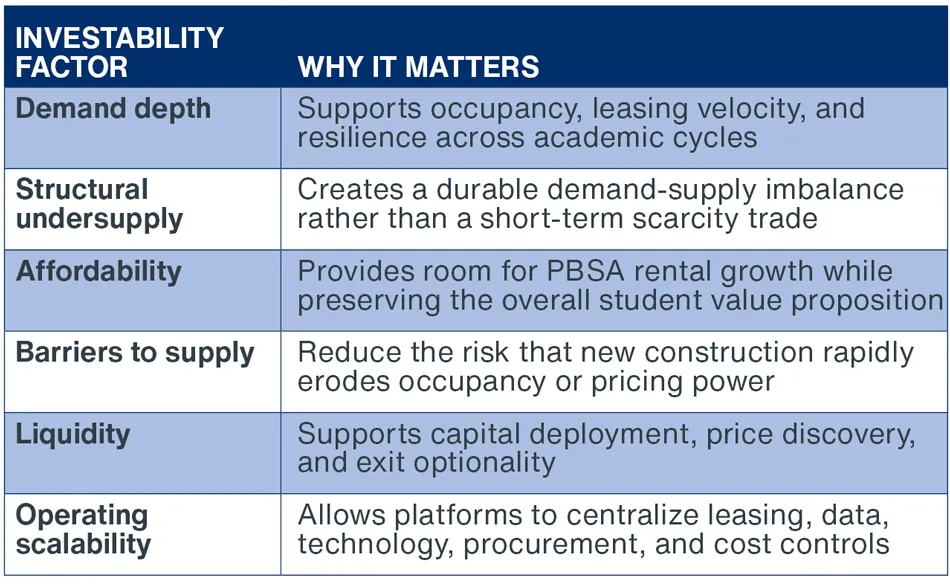
Market selection matters more than headline provision rates. The most attractive opportunities are where deep and durable demand, affordability, barriers to new supply, liquidity, and operating scalability converge, supported by a sufficient pipeline of institutional-quality assets to deploy capital at scale.
Returns can be driven by income growth and execution, not cap-rate compression. A disciplined entry basis, annual rent resets, and specialist operating platforms can translate structural demand into stronger leasing, pricing, stabilization, and cost control, compounding NOI and driving attractive returns.
Risk management starts with market selection and operating capability. Currency, regulation, liquidity, and execution risks vary materially market by market, reinforcing the importance of disciplined underwriting, market selection, local expertise, and scaled specialist operators that can adapt leasing, pricing, cost control, and stabilization strategies.
WHY NOW: STRUCTURAL DEMAND IS OUTPACING SUPPLY
Student demand across Europe continues to grow against a structurally constrained supply backdrop. The continent’s student population is forecast to increase by approximately 2.2 million between 2024/25 and 2029/30, reaching roughly 21 million students. PBSA stock is projected to grow by only approximately 500,000 beds, while new completions remain approximately 80% below incremental student additions.5 That growth represents a faster pace than the prior five years and is supported by favorable demographics, rising participation in higher education, and continued international student mobility.
The imbalance is particularly pronounced across Southern Europe, where provision remains low and demand is supported by rising higher-education participation, international student mobility, and attractive education economics. Spain has emerged as one of Europe’s fastest-growing higher education markets, while Madrid ranks among the region’s largest student cities. Portugal and Italy also benefit from internationally recognized universities, attractive urban locations, and a comparatively accessible cost of attendance relative to other major global education destinations.
Affordability provides an additional underwriting advantage. Europe remains a comparatively affordable study destination versus the U.S., UK, Australia and Canada, with Continental Europe—particularly Southern Europe—offering some of the most accessible tuition and living costs within the region. This relative affordability supports student mobility, broadens the addressable demand base, and reinforces demand resilience.
For owners, that affordability also creates room for PBSA rents to grow while preserving the broader student value proposition, providing a cushion for rental growth and supporting NOI durability.
SUPPLY IS STRUCTURALLY CONSTRAINED
New PBSA delivery is not keeping pace with student growth. Continental Europe has an average PBSA provision rate of roughly 15%, compared with more mature markets such as the UK, where provision is materially higher.6 Across Southern Europe, the gap is even wider: Spain has a national provision rate of approximately 8%,7 Portugal remains significantly undersupplied, and Italy’s PBSA provision remains low relative to its large student base.8
FIGURE 1: PBSA PROVISION RATES BY COUNTRY
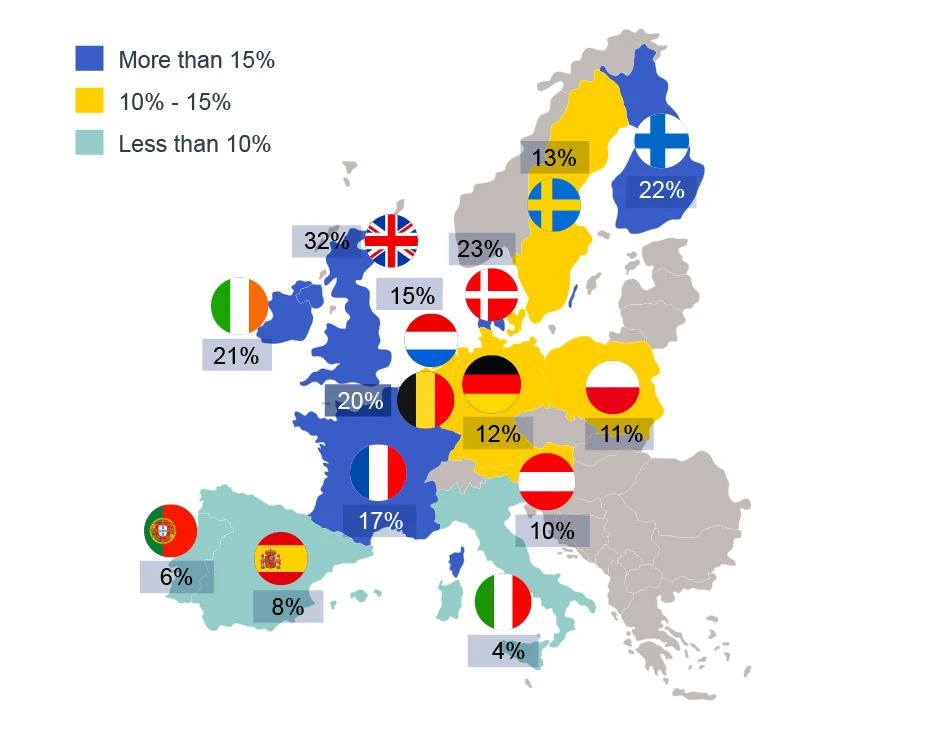
Source: JLL Research, 2025. Student numbers derived from national statistical offices. Total students reflect only full-time or in-person students. Refers to 2024/25 AY or latest available. Total provision rate is total PBSA beds divided
by total students.
The shortage reflects more than a lack of existing stock. Development pipelines are constrained by high construction costs, tighter financing, scarcity of well-located land, and lengthy permitting processes. In some cities, the absence of a dedicated PBSA licensing framework or the complexity of municipal planning systems further slows delivery.
These constraints matter for investors because they increase the durability of the supply-demand imbalance. In markets with sufficient demand depth, barriers to new supply can support occupancy, leasing visibility, rental growth, and stronger stabilized income. The opportunity is therefore not simply about today’s shortage; it is about the likelihood that shortages persist long enough for institutional owners and operators to benefit from them.
FROM UNDERSUPPLY TO INVESTABILITY
Low provision rates alone do not make the market attractive. Some markets may be undersupplied but too small, illiquid, unaffordable, or operationally fragmented to support scalable institutional investment. Conversely, highly mature markets may offer depth and liquidity but less room for further institutionalization or outsized income growth.
The most attractive PBSA opportunities are likely to sit between those extremes. Investors should focus on markets where structural undersupply is paired with deep student demand, relative affordability, barriers to supply, liquidity, operating scalability, and a sufficient pipeline of investable assets.
WHY SOUTHERN EUROPE STANDS OUT
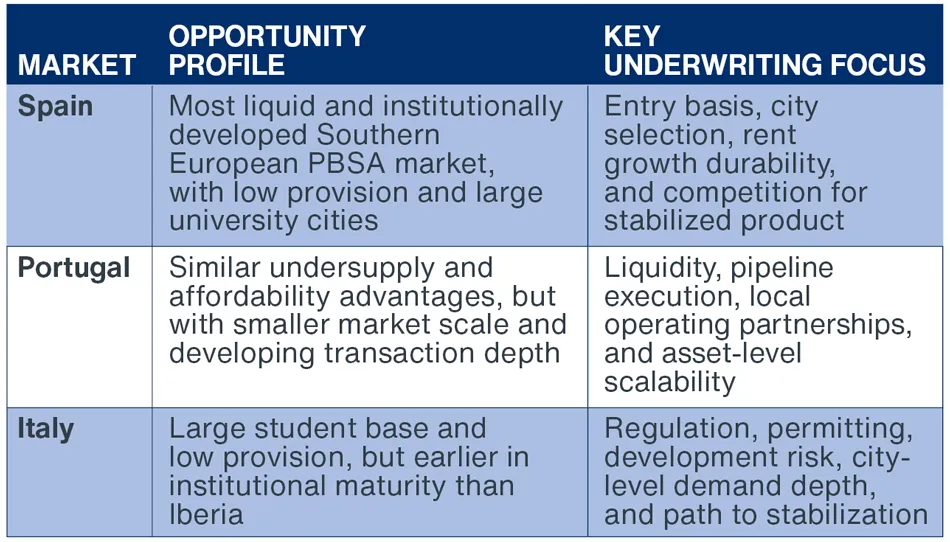
Southern Europe occupies an attractive position on this investability spectrum. The region combines characteristics that are rarely found together in more mature U.S. student housing markets: large university populations, very low institutional bed penetration, constrained development pipelines, growing international demand, and transaction markets that are becoming increasingly institutional. Several Southern European markets now have sufficient liquidity, operator depth, and institutional participation to support scalable investment strategies, while retaining meaningful runway for further growth.
Spain is the clearest example. The market combines large university markets, low provision, growing international enrollment, and a more established investment market. The country attracted approximately €1.7 billion of PBSA investment in 2025 and remains one of Continental Europe’s most active student housing markets.9 Yet national provision remains close to 8%, suggesting that institutional capital can access a market with both liquidity and significant growth potential.
Portugal shares many of Spain’s supply-demand characteristics but at a smaller scale. Lisbon and Porto remain structurally undersupplied, pipelines are limited, and the market is gradually becoming more institutional as operating assets stabilize and begin to trade. The smaller market size makes liquidity and platform scalability especially important underwriting considerations.
Italy remains earlier in its institutional evolution. Milan and Rome have large student populations and limited modern PBSA stock, creating a substantial theoretical opportunity. However, investors must underwrite execution risk, local regulation, development complexity, and the pace at which market liquidity and operating infrastructure continue to mature.
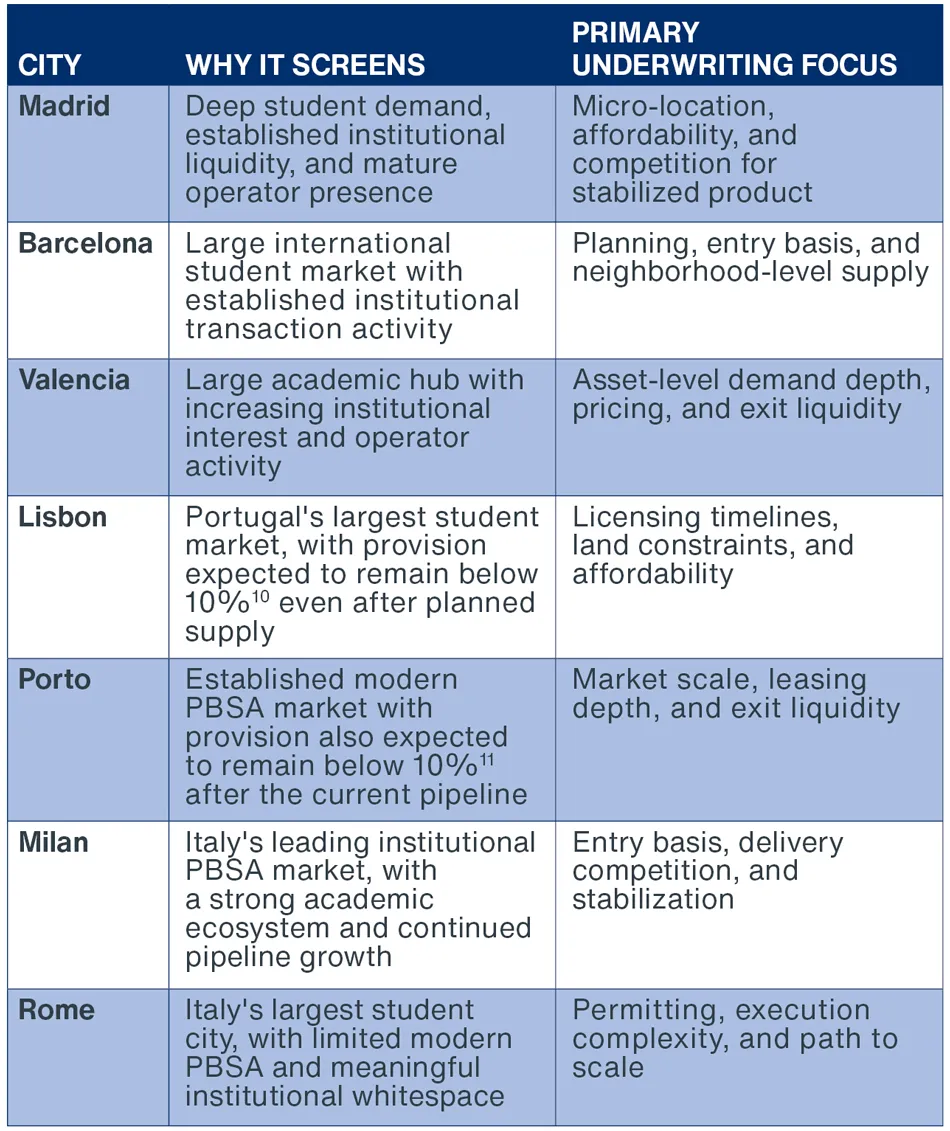
SELECTED CITY LENS
At the city level, undersupply is necessary but not sufficient. Underwriting turns on micro-location, affordability, delivery risk, operator depth, and exit liquidity. The objective is not to chase the lowest provision rate, but to invest where structural demand, asset quality, and institutional investability converge.
OPERATING PLATFORMS CONVERT DEMAND INTO NOI GROWTH
PBSA is an operationally intensive asset class wrapped in real estate. Leasing velocity, pricing, renewal behavior, student preferences, academic calendars, customer service, cost management, and local regulation all influence performance. These factors are especially important in Europe, where market practices vary meaningfully by country and city.
A dedicated, scaled operating platform can help convert favorable fundamentals into stronger asset-level outcomes. Centralized leasing, customer relationship management, university engagement, digital marketing, data-driven pricing, procurement, utilities management, and technology systems can improve occupancy, reduce costs, and accelerate stabilization.
- Leasing and revenue management: Scaled operators can track demand in real time, adjust pricing as inventory sells through, and improve lead-to-booking conversion, occupancy, and rents.
- Cost control: Scale can support centralized staffing, procurement, utilities management, and back-office functions, creating operating leverage.
- Technology and data: Portfolio-level booking and customer data can sharpen pricing, room mix, renewal strategy, and marketing spend.
In this context, operating capabilities at scale are a source of value creation. As European PBSA becomes more institutionalized, market selection, pricing discipline, customer acquisition, cost control, and portfolio-level data should become increasingly important drivers of NOI growth and risk management.
U.S. INVESTOR CONSIDERATIONS
The European PBSA opportunity is compelling, but investors should underwrite several risks that differ from more mature student housing markets.
- Currency: Euro-denominated income and valuations introduce foreign-exchange exposure for U.S. dollar-based investors.
- Regulation: Planning, permitting, rent regulation, tax treatment, and licensing requirements vary significantly by country and city.
- Liquidity: Continental European PBSA transaction markets are generally less deep than the more mature U.S. and UK markets, although liquidity continues to improve across the largest university cities and most institutional submarkets.
- Operating complexity: Academic calendars, leasing norms, consumer preferences, and market practices differ by country and city.
- Execution risk: Development, repositioning, and stabilization strategies require local expertise and strong operator alignment.
These risks do not diminish the investment case. They define where and how capital should be deployed. Market selection, entry basis, local knowledge, and operating execution are therefore central to underwriting, while the same fragmentation that creates complexity can also create barriers to entry and increase the value of scaled specialist platforms. For global institutional portfolios, European PBSA can also broaden exposure beyond traditional office, logistics, multifamily, and U.S. student housing allocations, with demand linked in part to university enrollment and international student mobility rather than conventional corporate space demand.
CONCLUSION
For U.S. institutional investors, European PBSA offers exposure to a familiar living-sector format at a materially earlier stage of institutionalization, with durable demand growth, constrained supply, and meaningful room for scaled ownership to expand.
The opportunity is most compelling where those structural tailwinds are matched by institutional investability, deep demand, attractive entry basis, barriers to new supply, transaction liquidity, and specialist operating capability. Southern Europe stands out on this basis: Spain offers the greatest combination of scale, liquidity, and institutional depth; Portugal remains materially undersupplied as the market continues to mature; and Italy provides earlier-stage exposure with significant runway for modern PBSA supply. In our view, this creates an unusual window in which investorscan access durable income while capturing value from the continued institutionalization of the sector.